

At a glance: MVHR systems from Poland
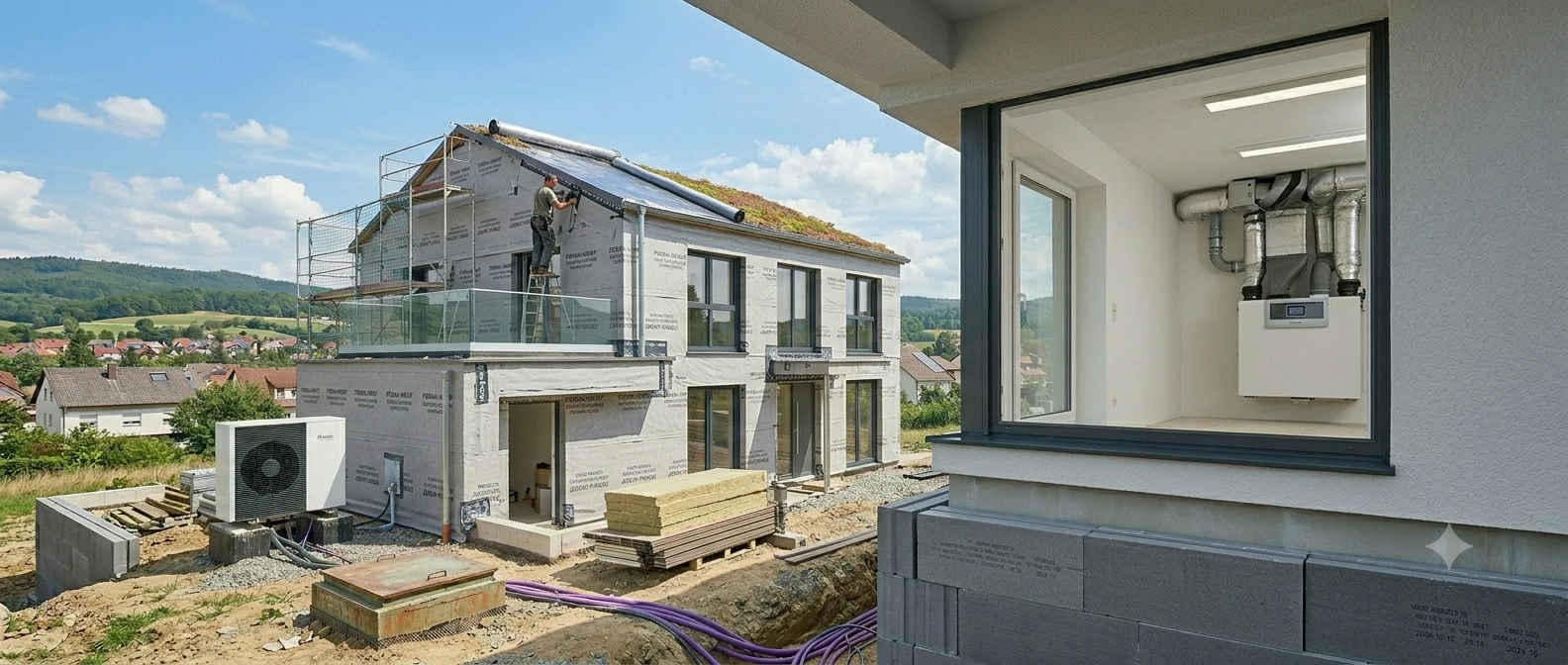
- 🌬️ The airtightness pay-off: the tighter a building is sealed — the XPS and airtightness detailing we've covered in recent guides — the more it depends on MVHR to supply fresh air without losing heat.
- 🏭 Established manufacturing base: Poland produces MVHR units, semi-rigid and flexible ductwork, and distribution manifolds at industrial scale for export across Europe.
- 📐 Sizing is project-specific: unit airflow capacity (m³/h) must be calculated from room volumes and occupancy, not selected from a generic "house size" chart.
- 🔧 Ductwork design matters as much as the unit: duct runs, bends and diffuser placement affect both efficiency and noise far more than the brand of the core unit.
Why MVHR follows naturally from airtightness and insulation
Our recent guides on XPS foundation insulation and ETICS render finishes both come back to the same underlying goal: a well-sealed, well-insulated building envelope. That same airtightness is exactly why mechanical ventilation with heat recovery has become close to standard on Irish nZEB and passive house projects — once a building is sealed tightly enough to meet current performance targets, it needs a mechanical system to supply fresh air and remove stale, humid air without throwing away the heat that airtightness and insulation worked to keep in.
Poland is a major European manufacturer of MVHR units and ductwork systems, giving Irish self-builders and contractors access to a wide range of unit capacities and duct components directly from factory.
1. Sizing the MVHR unit
- Airflow capacity: calculated in m³/h from room volumes, occupancy and required air changes, not estimated from floor area alone.
- Heat recovery efficiency: counter-flow heat exchangers typically achieve the highest recovery rates, an important figure for meeting nZEB and passive house performance targets.
- Summer bypass: confirm the unit includes a summer bypass function to avoid recovering unwanted heat during warm weather.
- Filtration: check filter class (commonly ePM1 or ePM10) if occupants have allergies or the site is in a higher-pollution area.
2. Ductwork: semi-rigid vs flexible
Semi-rigid ductwork offers lower resistance to airflow and is generally quieter than fully flexible ducting, making it the preferred choice for main runs, while flexible duct is often used for short final connections to diffusers. Duct sizing, bend radius and diffuser placement should be designed before first fix, not adjusted on site — a duct run added as an afterthought is one of the most common causes of a noisy or underperforming MVHR installation.
The fix that avoids a noisy system: specify semi-rigid duct for all main runs longer than a couple of metres, and confirm acoustic attenuators are included where ductwork passes close to bedrooms.
3. Commissioning and airtightness testing
An MVHR system is only as effective as the airtight envelope it serves. Coordinate the ductwork installation with your airtightness strategy — the membranes, tapes and collars covered in our earlier passive house guide — and commission the system with a full airflow balance once installation is complete, not just a visual check.
| Component | Key specification points | Why it matters |
|---|---|---|
| MVHR unit | Airflow capacity, heat recovery efficiency, summer bypass | Determines comfort and energy performance year-round |
| Semi-rigid ductwork | Diameter, bend radius, insulation where required | Reduces noise and airflow resistance |
| Diffusers & valves | Room-by-room airflow balancing | Ensures even, draught-free ventilation |
| Filters | Filter class (ePM1 / ePM10) | Affects indoor air quality and maintenance interval |
Specifying MVHR for your passive house or nZEB project?
Actitrade sources MVHR units, ductwork and accessories from established Polish manufacturers, checks sizing and specification against your build, and arranges delivery to your Irish site.
Start with our building materials sourcing proposal or contact Actitrade to discuss your ventilation system.